Financial Forecasting: Budgeting vs. Forecasting—Which One Do You Really Need?
The Keacast Philosophy Series – Episode 10 Why These Two Financial Tools Solve Different Problems Meta Description: Budgeting vs. forecasting—which one do you really need? Learn how budgeting and financial forecasting work together to improve cash flow planning and financial confidence. URL Slug: /keacast-philosophy/budgeting-vs-forecasting Primary Keyword: Budgeting vs Forecasting Secondary Keywords: Financial Forecasting, Cash Flow Planning, Future Cash Flow, Budget Planning, Financial...
The Keacast Philosophy Series – Episode 10
Why These Two Financial Tools Solve Different Problems
Meta Description: Budgeting vs. forecasting—which one do you really need? Learn how budgeting and financial forecasting work together to improve cash flow planning and financial confidence.
URL Slug: /keacast-philosophy/budgeting-vs-forecasting
Primary Keyword: Budgeting vs Forecasting
Secondary Keywords: Financial Forecasting, Cash Flow Planning, Future Cash Flow, Budget Planning, Financial Confidence, Personal Finance
A Debate That Misses the Point
Search online for "budgeting vs forecasting", and you'll quickly find strong opinions.
Some people say budgeting is outdated.
Others insist everyone should have a budget.
Some argue forecasting replaces budgeting.
Others believe budgeting is all anyone needs.
The discussion often becomes a debate.
But what if we're asking the wrong question?
Perhaps the question isn't:
Which one is better?
Perhaps it's:
What problem is each one designed to solve?
Because once we understand that, the debate begins to disappear.
Every Tool Has a Purpose
Walk into a toolbox and you'll find dozens of tools.
A hammer.
A screwdriver.
A tape measure.
A wrench.
Which one is the best?
You can't answer that until you know what you're trying to accomplish.
If you're measuring a room, the tape measure is indispensable.
If you're tightening a bolt, the wrench is exactly what you need.
No one argues that a hammer should replace a screwdriver.
They solve different problems.
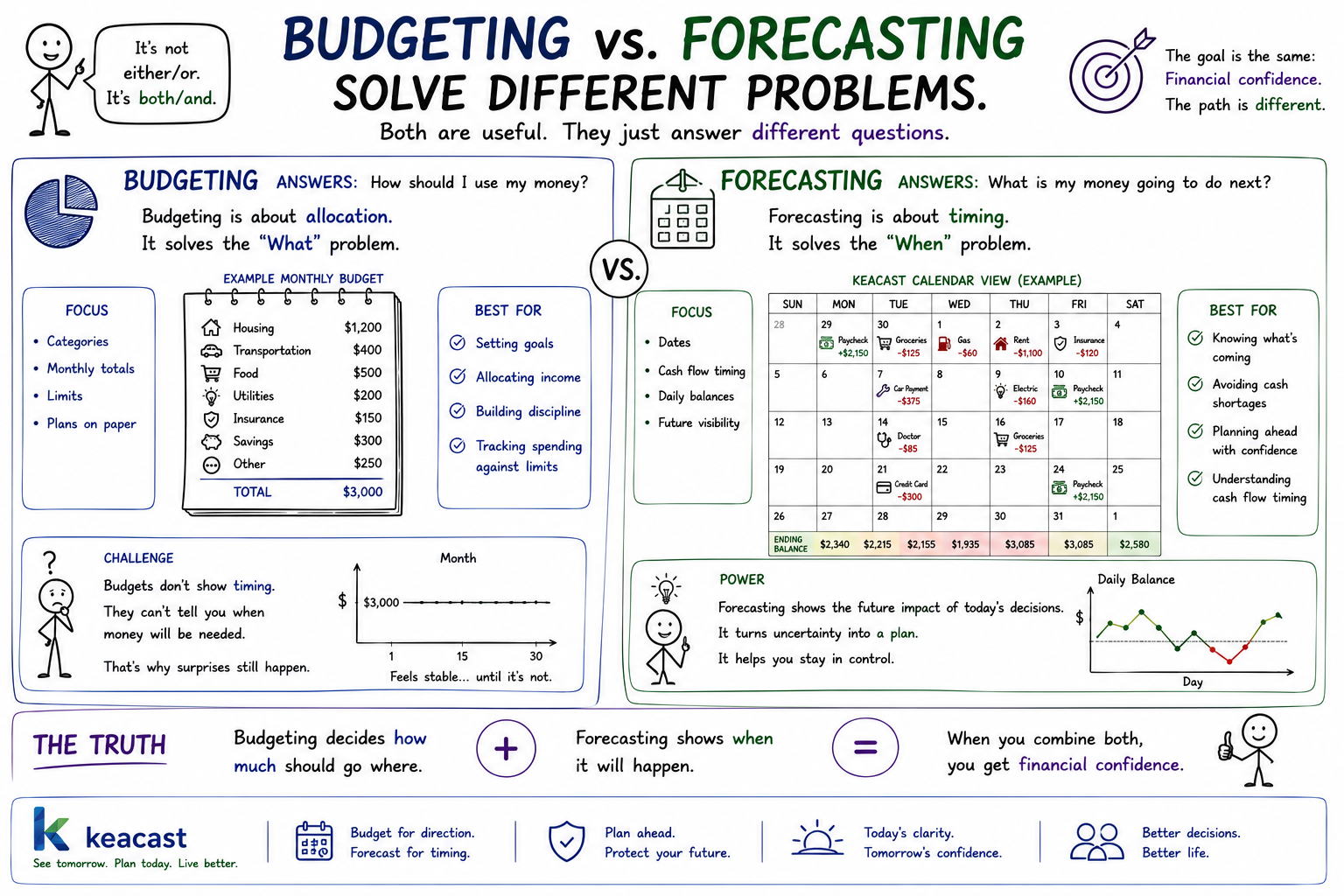
The same is true for budgeting and financial forecasting.
What Budgeting Does Exceptionally Well
Budgeting is one of the most valuable personal finance tools ever created.
It helps people:
Understand spending habits.
Set financial priorities.
Control unnecessary spending.
Allocate income intentionally.
Build savings.
Reduce debt.
Those are incredibly important goals.
Budgeting helps answer a question every household should ask:
"Where did my money go?"
That's a valuable question because it teaches awareness.
Understanding yesterday helps us make better choices tomorrow.
Then Life Asks a Different Question
Imagine you've carefully followed your budget all month.
You've stayed within your categories.
You've been disciplined.
Everything is going according to plan.
Then a friend calls.
"We're taking a weekend trip. Want to come?"
Immediately your mind asks,
"Can we afford it?"
Notice what changed.
Your budget may tell you how much remains in your entertainment category.
But that's not really what you're wondering.
You're asking:
"If we spend this money today, what happens next week?"
That's no longer a budgeting question.
It's a financial forecasting question.
Looking Back and Looking Forward
Imagine driving your car.
Your rearview mirror is important.
It tells you what's behind you.
It helps you understand where you've been.
But would you drive across the country using only your rearview mirror?
Of course not.
You also need the windshield.
The windshield doesn't replace the mirror.
It complements it.
Budgeting often functions like the rearview mirror.
Financial forecasting functions like the windshield.
Together, they give you a complete picture.
Two Questions Every Household Eventually Asks
After years of thinking about personal finance, I've noticed that almost every conversation eventually arrives at one of two questions.
The first is:
"Where did our money go?"
The second is:
"Are we going to be okay?"
The first question seeks understanding.
The second seeks confidence.
Budgeting answers the first beautifully.
Financial forecasting answers the second.
Together, they create something far more powerful than either tool can provide alone.
Why Timing Changes Everything
Throughout this series, we've discovered that every dollar has two attributes.
An amount.
And a date.
Budgeting naturally emphasizes the amount.
Financial forecasting emphasizes both.
That's why two families with identical budgets can experience completely different levels of financial stress.
One sees spending categories.
The other sees future cash flow.
The dollars haven't changed.
The visibility has.
Allocation Versus Navigation
Imagine preparing for a cross-country road trip.
Before leaving home, you decide how much you'll spend on fuel, hotels, food, and entertainment.
That's budgeting.
Now imagine you're halfway through the trip.
Construction closes the interstate.
Traffic slows your progress.
Weather forces a detour.
Now you need navigation.
Financial forecasting is the navigation system.
Budgeting helps allocate your resources.
Forecasting helps guide those resources through time.
That's why Keacast organizes money around time, not around accounts.
Because life isn't lived in categories.
It's lived one day at a time.
Why Financial Forecasting Builds Confidence
One of the biggest reasons people embrace financial forecasting is that it answers the question they're already asking.
Not,
"What did I spend?"
But,
"What happens next?"
A financial forecasting calendar helps answer that question by organizing future income, future expenses, and future cash flow into a single timeline.
As we've said throughout this series:
A financial forecasting calendar doesn't invent the future. It organizes it.
That organization transforms uncertainty into visibility.
And visibility creates confidence.
Choosing the Right Tool for the Right Question
The goal was never to replace budgeting.
The goal was never to abandon forecasting.
The goal is understanding which tool answers which question.
When you want to understand spending habits...
Budget.
When you want to understand future cash flow...
Forecast.
When you combine both, something remarkable happens.
You stop managing money one transaction at a time.
You begin navigating your financial future with intention.
Continue Your Financial Forecasting Journey
By now we've explored nearly every piece of the financial planning puzzle.
We've learned to organize money around time.
We've learned to forecast, reconcile, protect our financial intentions, and understand the rhythms of personal cash flow.
But one important challenge remains.
Very few people manage money entirely by themselves.
Most financial decisions affect someone else.
A spouse.
A partner.
An aging parent.
An adult child.
A roommate.
A business partner.
How do you build financial confidence when more than one person is involved?
In the next chapter, Financial Forecasting: Why Shared Financial Awareness Changes Everything, we'll discover why communication may be one of the most overlooked skills in personal finance—and how seeing the same financial future together can strengthen both planning and relationships.