Financial Forecasting: How Financial Confidence Changes Everything
The Keacast Philosophy Series – Episode 12 Why Seeing Your Future Cash Flow Can Transform the Way You Live With Money Meta Description: Discover how financial forecasting, future cash flow planning, and a financial forecasting calendar can reduce uncertainty and build lasting financial confidence. URL Slug: /keacast-philosophy/financial-confidence Primary Keyword: Financial Confidence Secondary Keywords: Financial Forecasting, Future Cash Flow, Cash Flow Planning, Financial Forecasting...
The Keacast Philosophy Series – Episode 12
Why Seeing Your Future Cash Flow Can Transform the Way You Live With Money
Meta Description: Discover how financial forecasting, future cash flow planning, and a financial forecasting calendar can reduce uncertainty and build lasting financial confidence.
URL Slug: /keacast-philosophy/financial-confidence
Primary Keyword: Financial Confidence
Secondary Keywords: Financial Forecasting, Future Cash Flow, Cash Flow Planning, Financial Forecasting Calendar, Personal Cash Flow, Planning Expenses
What Does Financial Confidence Really Mean?
Ask ten people what financial confidence looks like, and you may receive ten different answers.
For some, it means becoming debt-free.
For others, it means having a large emergency fund.
Some picture a comfortable retirement.
Others imagine owning a home, paying for their children’s education, or finally taking the vacation they have postponed for years.
Those are all meaningful goals.
But they do not fully explain financial confidence.
There are people with modest incomes who feel calm and prepared.
There are also people with substantial incomes who worry constantly.
If financial confidence depended only on the amount of money someone had, that would be difficult to explain.
Perhaps financial confidence comes from something more fundamental.
Perhaps it begins with understanding.
Financial Confidence Is Not the Same as Wealth
Wealth can create options.
Savings can provide protection.
Income can make financial challenges easier to manage.
But none of those automatically creates confidence.
A person can have money in the bank and still wonder:
“Am I forgetting a bill?”
“Will this purchase create a problem next week?”
“What happens after the mortgage payment clears?”
“Will my paycheck arrive before the next major expense?”
Those questions are not always caused by a lack of money.
They are often caused by a lack of visibility into future cash flow.
That is why financial confidence cannot be measured by today’s balance alone.
Confidence Is the Opposite of Uncertainty
At the beginning of this series, we explored one of the most important ideas in personal finance:
Financial stress often begins with uncertainty.
Not knowing whether you will have enough.
Not knowing when a bill will arrive.
Not knowing what future expenses are waiting.
Not knowing how today’s decisions will affect next week.
Financial confidence begins when those uncertainties become easier to understand.
It does not require knowing the future perfectly.
It requires seeing enough of the future to make thoughtful decisions today.
Seeing Replaces Guessing
Think about how many financial decisions are made with uncertain language.
“I think we can afford it.”
“I hope that payment clears after payday.”
“I believe the insurance bill is next week.”
“We should probably be okay.”
Words such as think, hope, believe, and probably are natural when the future is difficult to see.
Now imagine replacing those statements.
“I can see that the payment is covered.”
“I know when the insurance bill is scheduled.”
“I understand how this purchase changes next week’s balance.”
The financial circumstances may be exactly the same.
What changed was the visibility.
And visibility changes how people feel.
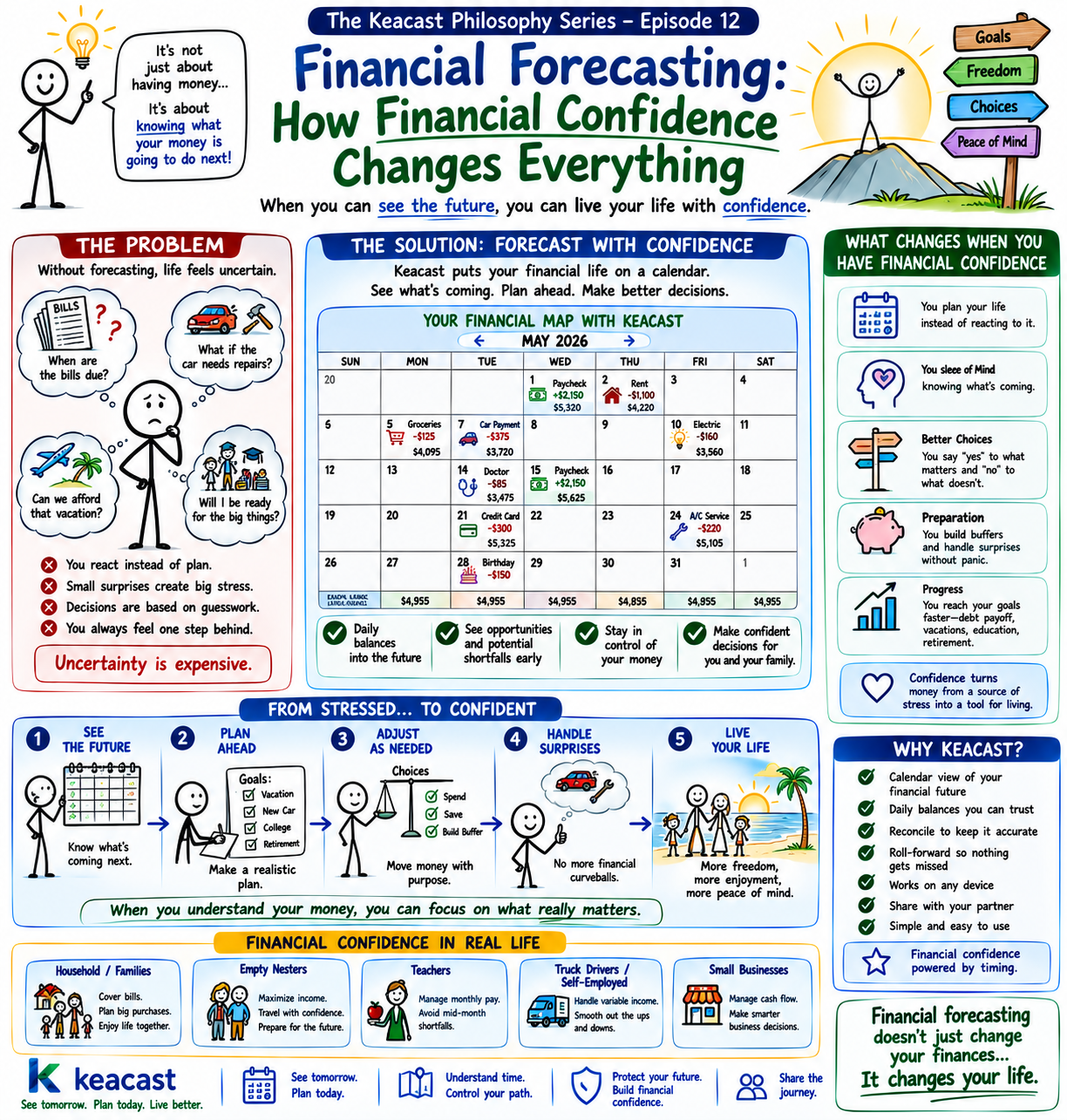
A Financial Forecasting Calendar Creates Clarity
Throughout this series, we have emphasized one of Keacast’s central principles:
A financial forecasting calendar does not invent the future. It organizes it.
Your future is already taking shape.
Your paycheck is expected on a date.
Your mortgage is due on a date.
Your insurance premium is scheduled for a date.
Your vacation, subscriptions, savings goals, and planned purchases all exist somewhere in time.
A financial forecasting calendar brings those events together in one picture.
It organizes money around time instead of separating it across accounts and transaction lists.
That allows you to see not only how much money you have, but what that money is expected to do next.
Organizing Money Around Time Changes Decisions
Traditional personal finance tools often organize money around accounts.
Checking.
Savings.
Credit cards.
Investments.
Those views are useful because they tell you where your money is today.
Keacast organizes money around time.
That helps answer a different question:
Where is your money going next?
When future income and expenses are placed on a timeline, decisions become easier to evaluate.
You can see whether a purchase fits comfortably.
You can recognize when several expenses will occur close together.
You can identify a future cash shortage while there is still time to respond.
That is the practical value of financial forecasting.
It turns uncertainty into information you can use.
Confidence Does Not Require Perfect Prediction
Financial forecasting is not fortune-telling.
You cannot predict every repair.
Every medical expense.
Every change in income.
Every opportunity.
Life will continue to surprise you.
The purpose of a forecast is not to eliminate uncertainty completely.
The purpose is to reduce avoidable uncertainty.
You may not know exactly what your grocery bill will be next month.
But you probably know that groceries will be needed.
You may not know the exact cost of your next vehicle repair.
But you can begin planning for future maintenance.
You may not know every detail of an upcoming vacation.
But you can place the expected cost into your future cash flow.
Financial confidence grows when you prepare for what you know while remaining flexible enough to respond to what you do not.
Preparation Changes the Experience of a Problem
Imagine two households receive the same unexpected bill.
The amount is identical.
The due date is identical.
One household immediately panics.
The other begins discussing options.
The difference may not be income.
It may be preparation.
One family saw that its future cash flow had room to absorb part of the expense.
The other had no clear picture of what was coming.
Preparation does not prevent every difficult moment.
But it can transform panic into planning.
That transformation is one of the greatest benefits of financial forecasting.
Reconciliation Keeps Confidence Connected to Reality
A forecast is only useful when it remains connected to real life.
That is why reconciliation is so important.
Your financial forecast says:
“This is what we expected.”
Your bank activity says:
“This is what actually happened.”
Reconciliation brings those two pictures together.
The goal is not to defend the original forecast.
Reality always gets the final word.
Instead, reconciliation allows yesterday’s real activity to improve tomorrow’s plan.
That keeps your financial forecasting calendar alive, current, and useful.
Confidence does not come from following an outdated plan.
It comes from understanding where you stand now and what happens next.
Netting Protects Your Financial Intentions
Financial confidence is also strengthened when your plan preserves purpose.
Suppose you reserve money for gasoline, groceries, vehicle maintenance, or another recurring expense.
If you spend less than expected, the remaining money does not suddenly lose its purpose.
Your responsibility continues.
Your intention continues.
Netting allows that remaining amount to carry forward toward the reason it was reserved.
That is why we say:
Netting protects your financial intentions.
It prevents your plan from restarting artificially simply because a paycheck arrived or a month ended.
Instead, your financial plan reflects the continuous nature of real life.
Budgeting and Forecasting Work Together
Budgeting and forecasting should not be treated as competitors.
They solve different problems.
Budgeting helps answer:
“Where should my money go?”
Financial forecasting helps answer:
“What will happen as my money moves through time?”
That is why another important Keacast principle is:
Budgeting helps you allocate money. Financial forecasting helps you navigate it.
Budgeting can help you establish priorities.
Forecasting can help you understand timing.
Budgeting can help explain spending.
Forecasting can help reveal future cash flow.
Together, they create a fuller picture of personal finance.
Shared Awareness Builds Shared Confidence
Financial confidence becomes even more powerful when it is shared.
A spouse may remember one upcoming bill.
A partner may be thinking about a different expense.
A caregiver may be managing finances for an aging parent.
A family may be coordinating savings goals, school costs, travel, and household obligations.
When people see different pieces of the financial picture, communication becomes harder.
When they see the same future cash flow, conversations change.
Instead of debating memory, they can discuss the same information.
Instead of asking whether someone remembered a payment, they can see it together.
Shared financial awareness reduces the burden on the person who has been carrying the entire financial calendar in their head.
Confidence grows when people stop managing separate pieces of the picture and begin seeing the same future together.
Financial Confidence Changes Everyday Life
Financial confidence is not only visible in major decisions.
It appears in ordinary moments.
Opening your banking app without feeling immediate anxiety.
Making a purchase without wondering what bill you forgot.
Planning a weekend trip with a clear understanding of the impact.
Discussing money with your spouse without relying on assumptions.
Recognizing a future problem early enough to make adjustments.
Knowing that today’s balance is not the entire story.
These moments may appear small.
Together, they change the experience of managing money.
A Different Definition of Financial Success
Personal finance is often measured using numbers.
Income.
Net worth.
Savings.
Debt.
Investment returns.
Those measures matter.
But perhaps financial success also includes something less visible.
The ability to sleep without constantly wondering whether you forgot something.
The ability to make decisions with understanding instead of fear.
The ability to look ahead and recognize both opportunities and risks.
The ability to adapt when life changes.
The ability to talk about money with greater clarity.
Those outcomes may not appear on a financial statement.
But they have tremendous value.
The Journey from Uncertainty to Confidence
Think back through the ideas we have explored in this series.
We learned that financial stress is often caused by uncertainty.
We learned that money is a flow, not a pile.
We discovered that every dollar has an amount and a date.
We began asking:
“What is my money going to do next?”
We learned the power of seeing money on a calendar.
We discovered that financial forecasting is preparation, not prediction.
We reframed reconciliation as the conversation between the plan and reality.
We learned that netting protects financial intentions.
We began understanding the language and rhythm of time.
We clarified that budgeting and forecasting solve different problems.
We explored how shared financial awareness improves communication.
None of those concepts stands alone.
Together, they form a system for navigating money through time.
Keacast Is Financial Navigation
A navigator needs several things.
A clear starting point.
A destination.
A route.
Awareness of changing conditions.
The ability to make adjustments.
Personal finance requires the same capabilities.
Your reconciled balance tells you where you are.
Your forecast shows where you are heading.
Your financial forecasting calendar reveals the path.
Reconciliation helps you adjust when reality changes.
Netting preserves the intentions you are carrying forward.
Shared awareness helps everyone involved navigate together.
That is why Keacast is more than a record of financial activity.
It is a system for financial navigation.
The Quiet Power of Knowing What Happens Next
Financial confidence does not mean every future balance will be positive.
It does not mean every decision will be easy.
It does not mean financial challenges will disappear.
Sometimes the forecast will reveal a difficult week.
A low balance.
An approaching expense.
A decision that needs to be postponed.
But even uncomfortable information has value when it arrives early.
Because seeing a problem in advance gives you something uncertainty never does.
Time.
Time to adjust.
Time to prepare.
Time to communicate.
Time to make a better decision.
That may be the quietest and most powerful benefit of financial forecasting.
Where the Keacast Philosophy Leads
The Keacast Philosophy began with a question:
Why do so many people feel financially stressed?
The answer led us away from balances and toward timing.
Away from isolated transactions and toward cash flow.
Away from memory and toward visibility.
Away from static plans and toward plans that adapt.
Away from managing money as a pile and toward navigating it as a flow.
The goal was never perfect prediction.
The goal was never complete control.
The goal was to create a clearer relationship with tomorrow.
Because financial confidence does not come from knowing everything that will happen.
It comes from understanding enough of what is ahead to take the next step with intention.
And once your future cash flow becomes visible, one final question remains:
What could change in your life if you no longer had to guess what your money was going to do next?
Related Keacast Resources
Explore the tools and ideas that support financial confidence:
- Keacast Homepage – Discover a different philosophy of personal finance built around time, visibility, and future cash flow. Keacast.app
- Financial Forecasting Calendar – Organize future income, expenses, and daily balances into one visual timeline.
- Financial Forecasting Features – Explore the tools that support planning, navigation, and financial confidence.
- Reconciliation – Keep your financial forecast connected to actual bank activity.
- Shopping Lists – Plan everyday purchases while understanding their effect on future cash flow.
- Pricing – Review Keacast subscription options and select the plan that supports your financial goals.
- Episode 1: Financial Forecasting—Why Most People Feel Financially Stressed – Return to the beginning of the Keacast Philosophy Series.