Financial Forecasting: Why Shared Financial Awareness Changes Everything
The Keacast Philosophy Series – Episode 11 How Better Financial Communication Builds Financial Confidence. Meta Description: Discover why shared financial awareness improves communication, financial forecasting, and cash flow planning for couples, families, and anyone managing money together. URL Slug: /keacast-philosophy/shared-financial-awareness Primary Keyword: Shared Financial Planning Secondary Keywords: Financial Communication, Financial Forecasting, Cash Flow Planning, Family...
The Keacast Philosophy Series – Episode 11
How Better Financial Communication Builds Financial Confidence.
Meta Description: Discover why shared financial awareness improves communication, financial forecasting, and cash flow planning for couples, families, and anyone managing money together.
URL Slug: /keacast-philosophy/shared-financial-awareness
Primary Keyword: Shared Financial Planning
Secondary Keywords: Financial Communication, Financial Forecasting, Cash Flow Planning, Family Financial Planning, Financial Confidence, Personal Cash Flow
Most Financial Problems Aren't Really About Money
When people think about financial stress, they usually picture numbers.
Income.
Debt.
Expenses.
Savings.
But after years of observing how families manage money, I've become convinced that another problem quietly exists beneath the surface.
Many financial problems are actually communication problems.
Not because people don't care.
Not because they're irresponsible.
But because they're making decisions from different information.
And when people see different financial pictures...
...they naturally make different financial decisions.
Everyone Sees a Different Piece of the Puzzle
Imagine working on a thousand-piece puzzle.
One person has the top-left corner.
Someone else has the bottom edge.
Another person has the center.
Each person believes they're making progress.
But no one can see the complete picture.
Managing money together often feels exactly like that.
One spouse remembers the mortgage.
The other remembers the upcoming vacation.
Someone else is thinking about school supplies.
Another person remembers the insurance renewal.
Everyone is trying to help.
They're simply looking at different pieces of the future.
Communication Isn't the Problem
Have you ever heard couples say,
"We need to communicate better about money."
That's good advice.
But I don't think communication is usually the real problem.
Imagine two pilots flying the same airplane.
They communicate perfectly.
But one pilot is looking at yesterday's weather report.
The other is looking at today's radar.
No amount of communication fixes the problem.
They aren't working from the same information.
The issue isn't communication.
It's shared awareness.
The same thing happens in personal finance.
Different Information Creates Different Decisions
Imagine a husband stopping by the hardware store after work.
He checks the checking account.
The balance looks healthy.
"We can afford this."
Meanwhile, his wife remembers something he doesn't.
The homeowner's insurance premium drafts tomorrow morning.
She reaches the opposite conclusion.
"We should probably wait."
Who's right?
They both are.
One is looking at today.
The other is looking at tomorrow.
The disagreement isn't about money.
It's about visibility.
A Financial Forecasting Calendar Creates Shared Visibility
Earlier in this series, we introduced one of Keacast's core principles:
A financial forecasting calendar doesn't invent the future. It organizes it.
Now let's take that idea one step further.
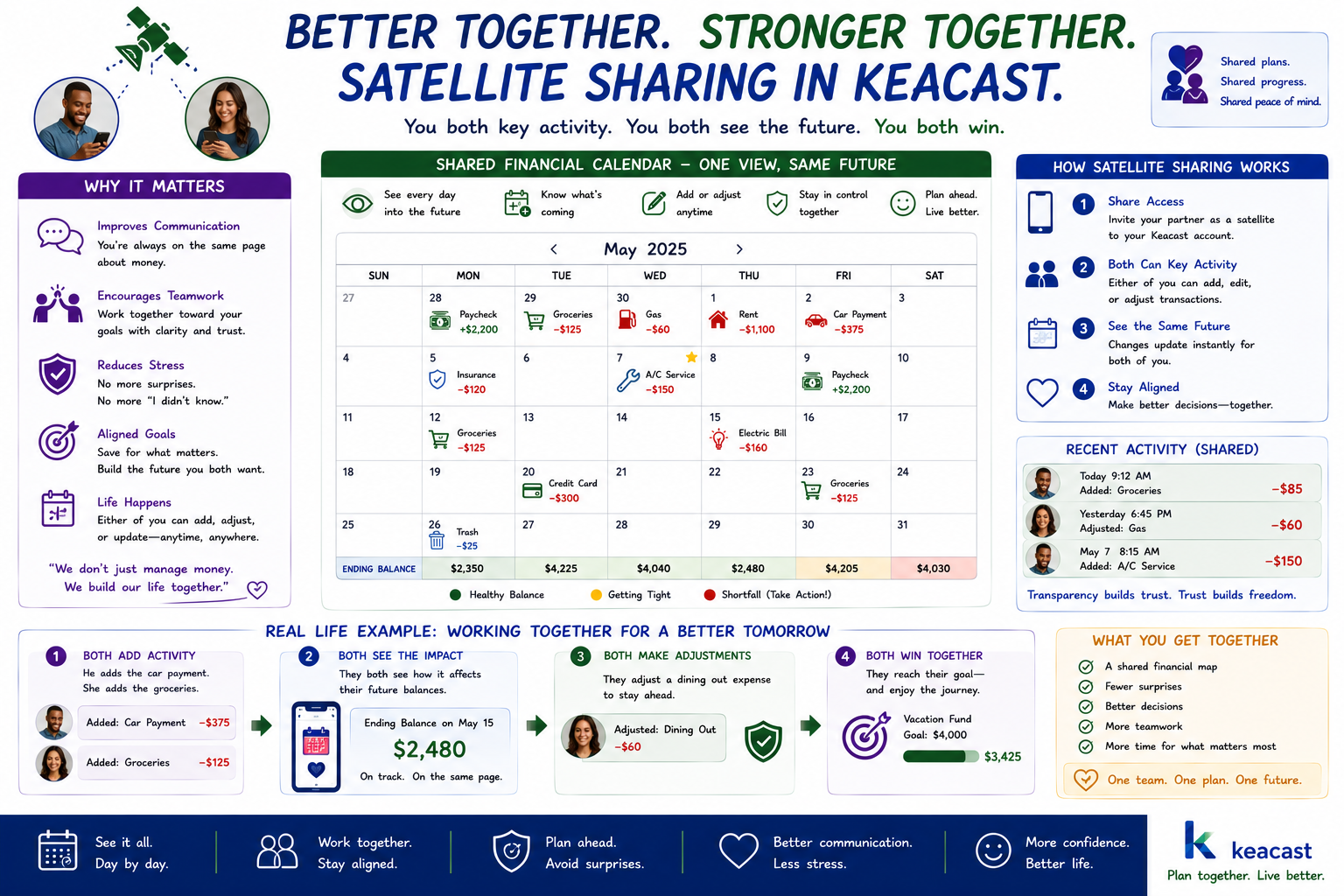
When everyone can see the same financial forecasting calendar, they begin making decisions from the same picture.
Instead of asking each other to remember every paycheck...
Every recurring expense...
Every future bill...
The calendar becomes the shared point of reference.
That's a fundamentally different approach to family financial planning.
Organizing Money Around Time Helps Everyone
Traditional financial tools organize money around accounts.
Checking.
Savings.
Credit cards.
Investment accounts.
Those views answer an important question.
Where is my money today?
Keacast organizes money around time.
That answers a different question.
What will our money be doing tomorrow?
When everyone sees that timeline together, financial conversations become much simpler.
Because everyone is looking at the same future.
The Invisible Mental Load
In many households, one person quietly becomes the financial memory.
They remember:
The mortgage.
The insurance renewal.
The car payment.
The school expenses.
The annual subscriptions.
The birthday gifts.
The property taxes.
The vacation savings.
The medical bills.
They become the human calendar.
At first, that responsibility seems manageable.
Over time, it becomes exhausting.
Not because the person lacks ability.
Because memory was never designed to carry an entire household's financial future.
Shared Awareness Changes the Conversation
Think about how financial conversations sound in many homes.
"Did you pay the electric bill?"
"When do we get paid again?"
"Can we afford this?"
"I forgot about the insurance payment."
Now imagine those same conversations after everyone shares the same financial forecast.
"I see the paycheck arrives Friday."
"The insurance payment is next week."
"If we buy this today, our balance still looks good."
Notice the difference.
The conversation becomes less emotional.
Less uncertain.
More collaborative.
People stop debating memories.
They begin discussing the same information.
Financial Confidence Is Meant to Be Shared
Imagine planning a family vacation.
Would one person secretly keep the itinerary while everyone else guessed what was happening?
Of course not.
Everyone benefits from seeing the plan.
Financial planning should work the same way.
The goal isn't giving everyone more spreadsheets.
The goal is giving everyone a shared understanding of the future.
That's what creates confidence.
Not because every decision becomes easy.
Because everyone begins making decisions together.
Better Communication Begins with Better Visibility
One of the most overlooked truths in personal finance is this:
Better communication rarely begins with talking more.
It begins with seeing the same information.
When people share the same financial picture...
Communication becomes easier.
Planning becomes calmer.
Financial decisions become more thoughtful.
That's the power of shared financial awareness.
It strengthens relationships by reducing uncertainty.
Continue Your Financial Forecasting Journey
Throughout this series we've gradually built a different way of thinking about personal finance.
We've learned that money is a flow.
Every dollar has an amount and a date.
Financial forecasting organizes the future instead of predicting it.
Reconciliation keeps the plan alive.
Netting protects our financial intentions.
Budgeting allocates money.
Forecasting helps us navigate it.
Shared awareness allows us to navigate together.
But one final question remains.
What does all of this ultimately create?
Why does seeing the future matter so much?
Why does organizing money around time change the way people feel?
In the final chapter, Financial Forecasting: How Financial Confidence Changes Everything, we'll bring every idea in this series together and explore the real destination of the Keacast philosophy.