Financial Forecasting: Understanding the Language of Time
The Keacast Philosophy Series – Episode 9 Why Cash Flow Planning Begins with Financial Rhythm Meta Description: Discover why understanding the language of time is essential for financial forecasting, cash flow planning, and managing future expenses with confidence. URL Slug: /keacast-philosophy/language-of-time Primary Keyword: Financial Forecasting Secondary Keywords: Cash Flow Planning, Future Cash Flow, Financial Forecasting Calendar, Financial Rhythm, Planning Expenses, Personal Cash...
The Keacast Philosophy Series – Episode 9
Why Cash Flow Planning Begins with Financial Rhythm
Meta Description: Discover why understanding the language of time is essential for financial forecasting, cash flow planning, and managing future expenses with confidence.
URL Slug: /keacast-philosophy/language-of-time
Primary Keyword: Financial Forecasting
Secondary Keywords: Cash Flow Planning, Future Cash Flow, Financial Forecasting Calendar, Financial Rhythm, Planning Expenses, Personal Cash Flow, Financial Confidence
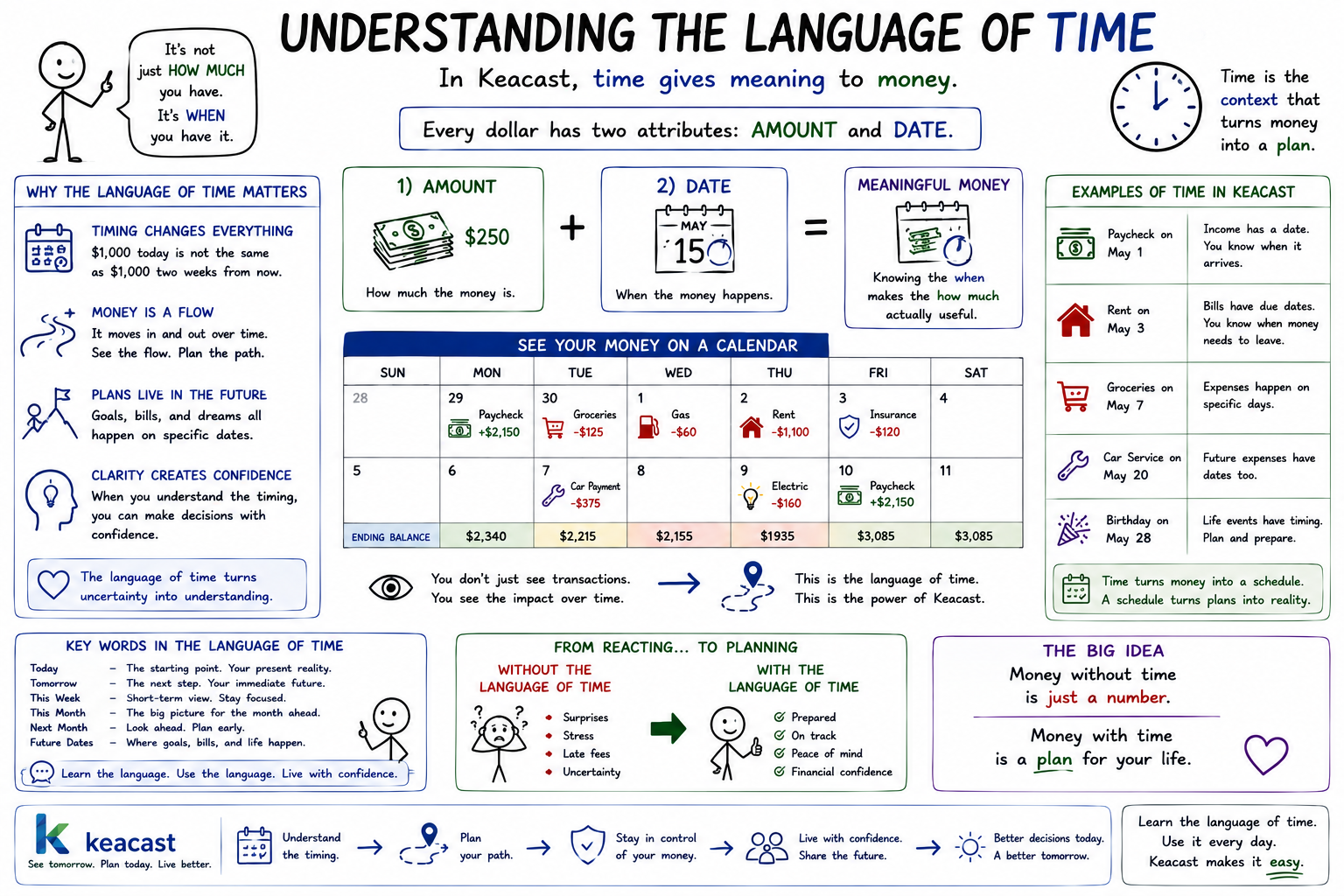
Money Speaks a Language
Every language has words.
Every language has patterns.
Every language has rules that help us understand meaning.
When you first learned to read, individual letters slowly became words.
Words became sentences.
Eventually, you stopped thinking about grammar and simply understood the message.
Money has a language too.
The surprising part is that very few of us have ever been taught to recognize it.
We Learn Dollars Before We Learn Time
Ask someone about their finances and the conversation almost always begins with numbers.
"How much do you earn?"
"How much is your mortgage?"
"How much have you saved?"
Those are important questions.
But notice something.
Almost no one begins by asking,
"When does your paycheck arrive?"
"When is your mortgage due?"
"When does your insurance draft?"
"When do your largest expenses occur?"
Those questions often determine whether someone feels financially confident.
Not because they change the amount of money.
Because they change the timing.
Every Financial Event Has a Rhythm
Think about the financial events in your own life.
Your paycheck.
Your mortgage.
Your rent.
Your utilities.
Your insurance.
Your streaming subscriptions.
Your property taxes.
Your holiday shopping.
Each one has a rhythm.
Weekly.
Biweekly.
Semi-monthly.
Monthly.
Quarterly.
Semiannual.
Annual.
Those aren't just scheduling options.
They are the natural rhythms of your financial life.
And understanding those rhythms is one of the foundations of cash flow planning.
Cash Flow Is Built on Rhythm
Imagine listening to your favorite song.
If every note played at the exact same time, there wouldn't be music.
There would only be noise.
Music exists because every note has both an order and a rhythm.
Money behaves the same way.
Your paycheck has a rhythm.
Your bills have rhythms.
Your savings goals have rhythms.
Your recurring expenses have rhythms.
Together, they create the rhythm of your personal cash flow.
Why Financial Planning Feels So Difficult
Have you ever tried answering this question?
"How much money will I have three Thursdays from now?"
Most people immediately begin doing mental calculations.
"When's payday?"
"What bills happen before then?"
"When does the insurance payment draft?"
"What about groceries?"
"What about the credit card payment?"
Notice something.
The difficult part isn't arithmetic.
It's translating dozens of different financial rhythms inside your head.
That's why managing money often feels mentally exhausting.
Not because it's complicated.
Because your brain is trying to coordinate multiple timelines at once.
We Live on Different Financial Clocks
One of the fascinating realities of personal finance is that almost nothing operates on the same schedule.
Your employer pays you every other Friday.
Your mortgage is monthly.
Your insurance may be quarterly.
Your property taxes arrive once each year.
Your groceries happen continuously.
Your vehicle maintenance appears whenever your car needs attention.
Life doesn't organize itself around one calendar.
Instead, it creates overlapping financial rhythms.
Understanding those rhythms is what transforms financial forecasting from a list of transactions into a meaningful plan.
Why a Financial Forecasting Calendar Changes Everything
Earlier in this series we introduced one of the core ideas behind Keacast.
A financial forecasting calendar doesn't invent the future. It organizes it.
This chapter explains why that matters.
A financial forecasting calendar doesn't simply display dates.
It organizes every financial rhythm into one visual timeline.
Instead of remembering that your paycheck is biweekly while your mortgage is monthly and your insurance is quarterly...
...you simply see them.
Your financial life becomes easier to understand because your brain no longer has to translate dozens of independent schedules.
The calendar becomes your interpreter.
Financial Confidence Comes from Understanding Patterns
Think about driving through an unfamiliar city.
The first few turns require concentration.
Eventually, the streets begin making sense.
You recognize landmarks.
You anticipate intersections.
You know what's coming next.
Financial planning works exactly the same way.
When you understand the rhythms of your income and future expenses, you stop feeling surprised by them.
You begin anticipating them.
That anticipation creates confidence.
Organizing Money Around Time
Traditional financial software organizes information around accounts.
Checking.
Savings.
Credit cards.
Investments.
Keacast takes a different approach.
It organizes money around time.
Because life doesn't happen inside accounts.
Life happens one day at a time.
Paychecks arrive on days.
Bills are due on days.
Vacations begin on days.
Savings goals are achieved over days.
Time is the common language connecting every financial decision.
That's why organizing money around time creates a clearer picture of your future cash flow.
Financial Fluency Is About More Than Numbers
The goal of financial forecasting isn't simply understanding dollars.
It's understanding how dollars move through time.
When you become fluent in the language of time, something remarkable happens.
Planning becomes easier.
Future expenses become less intimidating.
Cash flow becomes more predictable.
Financial decisions become more intentional.
Not because life changed.
Because you learned to read the language your money has been speaking all along.
Continue Your Financial Forecasting Journey
By now, we've learned to think about money differently.
We've learned that money is a flow.
Every dollar has an amount and a date.
Financial forecasting organizes the future instead of predicting it.
Reconciliation keeps the plan alive.
Netting protects our financial intentions.
And now we've learned to understand the rhythm that connects everything together.
But another important question remains.
If financial forecasting is so powerful...
How does it compare to budgeting?
Do you have to choose one?
Or are they solving completely different problems?
In the next chapter, Financial Forecasting: Budgeting vs. Forecasting—Which One Do You Really Need? we'll explore why these two approaches aren't competitors at all. They're simply answering different questions.