Financial Forecasting: Forecasting Your Future
The Keacast Philosophy Series – Episode 6 Why Financial Forecasting Is About Preparation, Not Prediction Meta Description: Learn why financial forecasting isn't about predicting the future—it's about preparing for it. Discover how a financial forecasting calendar helps you plan future cash flow with confidence. URL Slug: /keacast-philosophy/forecasting-your-future Primary Keyword: Financial Forecasting Secondary Keywords: Financial Forecasting Calendar, Future Cash Flow, Cash Flow Planning,...
The Keacast Philosophy Series – Episode 6
Why Financial Forecasting Is About Preparation, Not Prediction
Meta Description: Learn why financial forecasting isn't about predicting the future—it's about preparing for it. Discover how a financial forecasting calendar helps you plan future cash flow with confidence.
URL Slug: /keacast-philosophy/forecasting-your-future
Primary Keyword: Financial Forecasting
Secondary Keywords: Financial Forecasting Calendar, Future Cash Flow, Cash Flow Planning, Personal Cash Flow, Planning Expenses, Financial Confidence, Paycheck Planning
Why the Word "Forecasting" Scares So Many People
Mention financial forecasting, and many people immediately become uncomfortable.
"I can't predict the future."
"What if my numbers aren't perfect?"
"Life changes too much."
Those concerns are understandable.
After all, we usually hear the word forecast in situations where no one really knows what will happen.
Weather forecasts.
Stock market forecasts.
Economic forecasts.
Election forecasts.
In each case, people are trying to predict events outside their control.
But personal financial forecasting is completely different.
It's not about predicting the unpredictable.
It's about organizing what you already know.
Your Financial Life Is More Predictable Than You Think
Consider the next thirty days.
Do you know when your next paycheck is expected?
Probably.
Do you know when your mortgage is due?
Almost certainly.
How about your insurance payment?
Your internet bill?
Your streaming subscriptions?
Your car payment?
Those aren't guesses.
They're already part of your financial life.
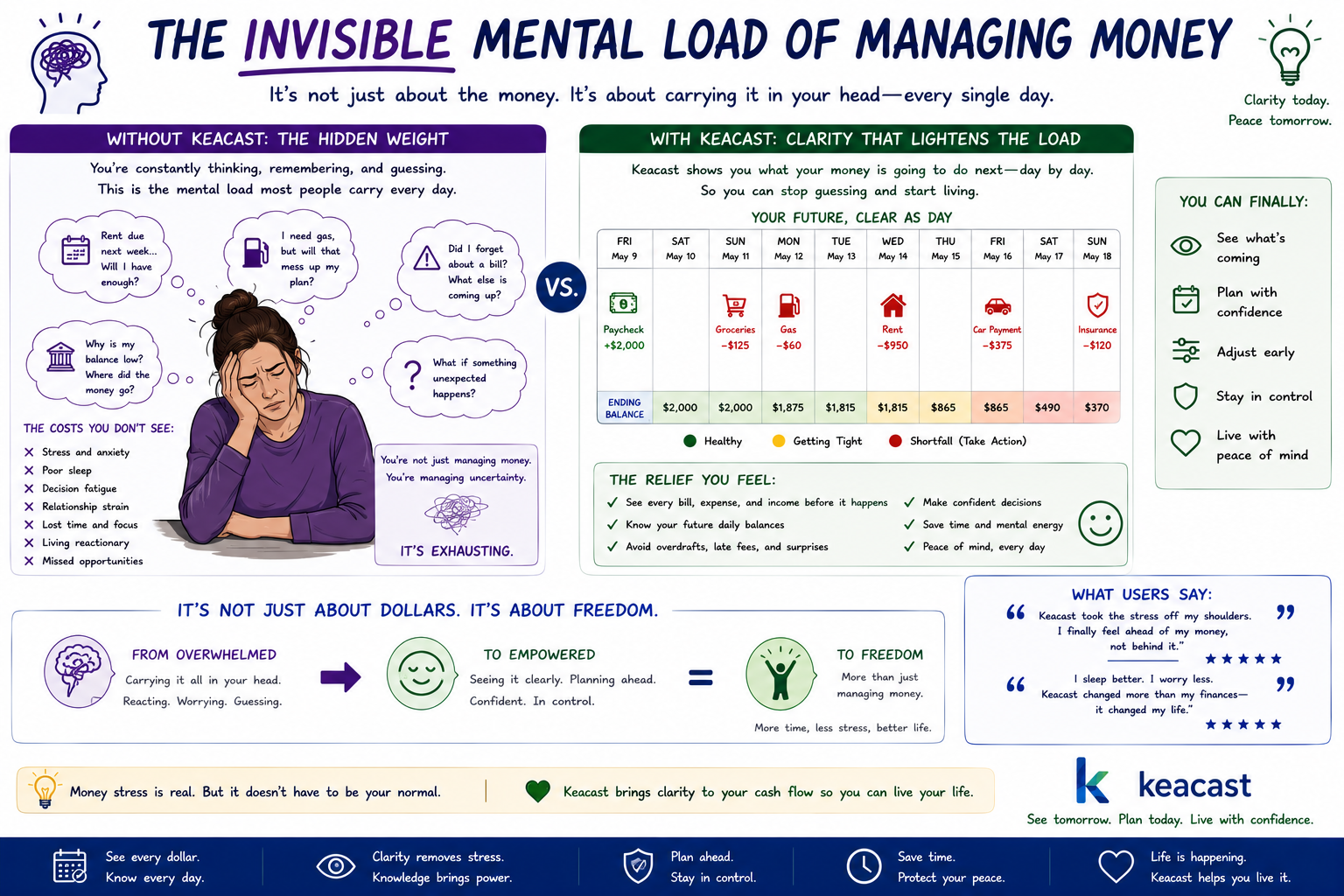
Financial forecasting simply places those known events into a timeline so you can understand how they interact.
That's why we believe a financial forecasting calendar is so powerful.
It doesn't invent the future.
It organizes it.
You're Already Forecasting Every Day
Whether you realize it or not, you're already forecasting.
You probably say things like:
"I get paid next Friday."
"The mortgage comes out on the first."
"We need to save for vacation."
"Property taxes are due in October."
"Christmas is only a few months away."
Those aren't predictions.
They're financial plans.
Your brain naturally thinks ahead.
The challenge is that you're trying to manage dozens—or even hundreds—of future events entirely from memory.
Eventually, memory becomes the weakest part of your financial system.
Why Memory Was Never Meant to Manage Your Money
Think about everything you're trying to remember.
Paychecks.
Bills.
Subscriptions.
Insurance renewals.
School expenses.
Birthdays.
Vehicle maintenance.
Medical appointments.
Holiday shopping.
Savings goals.
Future vacations.
Now imagine trying to remember all of that six months from now.
It's exhausting.
Not because you're disorganized.
Because your brain wasn't designed to function as a financial forecasting calendar.
It was designed to make decisions.
The more information you can move from memory into a visual plan, the more mental energy you free for better decision-making.
Forecasting Creates a Conversation with Tomorrow
Imagine tomorrow could speak.
What would it tell you?
"Don't forget your insurance payment."
"Your paycheck arrives in two days."
"Next week has three large bills."
"You'll have extra room in your cash flow after Friday."
Tomorrow already contains valuable information.
The problem isn't that tomorrow is unknowable.
The problem is that most people can't see it.
Financial forecasting allows tomorrow to participate in today's decisions.
Why a Financial Forecasting Calendar Changes Everything
This is one of the biggest differences between traditional money management and the Keacast philosophy.
Most financial software organizes information around accounts.
Checking.
Savings.
Credit cards.
Investment accounts.
Those views tell you where your money is.
A financial forecasting calendar tells you when your money will be needed.
That's a completely different perspective.
Instead of asking,
"What's my balance?"
You begin asking,
"What happens next Tuesday?"
Or...
"How will this purchase affect next week's cash flow?"
Those are the questions that build confidence.
Seeing Problems Before They Become Emergencies
Imagine driving down a highway at night.
Your headlights don't remove the curves.
They don't eliminate construction.
They don't prevent traffic.
What they do is help you see what's coming.
Financial forecasting works the same way.
Perhaps you discover that your future cash flow becomes tight three weeks from now.
Wonderful.
Not because anyone enjoys financial challenges.
But because you discovered the issue while you still had time to do something about it.
Preparation is almost always less stressful than reaction.
Financial Forecasting Doesn't Need to Be Perfect
One of the biggest myths about financial forecasting is that it must be exact.
It doesn't.
Think about a GPS.
Does it know about every traffic light you'll encounter?
Every driver?
Every unexpected delay?
Of course not.
Yet it still helps millions of people reach their destination every day.
Its value comes from providing direction—not perfection.
Your financial forecast serves the same purpose.
It gives you a clearer path forward.
As life changes, the plan changes too.
That's exactly how it should work.
Financial Confidence Comes from Visibility
Many people believe confidence comes from certainty.
Life rarely offers certainty.
What it can offer is visibility.
When you understand your future cash flow...
When you can see upcoming income and future expenses...
When your paycheck planning extends beyond memory and onto a calendar...
You begin making decisions with greater confidence.
Not because life became easier.
Because life became clearer.
A Better Way to Prepare for Tomorrow
Financial forecasting isn't about trying to predict every twist and turn of life.
It's about creating a clear picture using everything you already know.
Income.
Bills.
Savings goals.
Recurring expenses.
Future obligations.
When those pieces are organized on a financial forecasting calendar, tomorrow becomes far less mysterious.
And that's where financial confidence begins.
Continue Your Financial Forecasting Journey
Of course, every financial forecast eventually meets reality.
A grocery bill is a little higher than expected.
A paycheck changes.
An unexpected repair appears.
Life does what life has always done.
It changes.
Does that mean the forecast has failed?
Not at all.
In fact, that's where one of the most important ideas in the Keacast philosophy begins.
A forecast should never compete with reality.
It should learn from it.
In the next chapter, Financial Forecasting: Why Reconciliation Keeps Your Financial Plan Alive, we'll explore how your forecast evolves every day—remaining accurate not because it never changes, but because it's constantly connected to what actually happens.