Financial Forecasting: How Netting Protects Your Financial Intentions
The Keacast Philosophy Series – Episode 8 A Better Way to Plan Recurring Expenses and Future Cash Flow Meta Description: Learn how netting helps protect your financial intentions by carrying forward unused money for recurring expenses. Improve your financial forecasting and cash flow planning. URL Slug: /keacast-philosophy/netting-financial-intentions Primary Keyword: Financial Forecasting Secondary Keywords: Recurring Expenses, Cash Flow Planning, Sinking Funds, Future Expenses, Personal...
The Keacast Philosophy Series – Episode 8
A Better Way to Plan Recurring Expenses and Future Cash Flow
Meta Description: Learn how netting helps protect your financial intentions by carrying forward unused money for recurring expenses. Improve your financial forecasting and cash flow planning.
URL Slug: /keacast-philosophy/netting-financial-intentions
Primary Keyword: Financial Forecasting
Secondary Keywords: Recurring Expenses, Cash Flow Planning, Sinking Funds, Future Expenses, Personal Cash Flow, Financial Confidence
What Happens to the Money You Didn't Spend?
Imagine you've decided to reserve $200 from every paycheck for gasoline.
Not because you know exactly how much you'll spend.
Because experience tells you that's usually enough.
A week later you fill your tank.
The total is $54.18.
Now ask yourself a simple question.
What happens to the remaining money?
Surprisingly, most financial tools don't have a very good answer.
We Naturally Think About Purpose
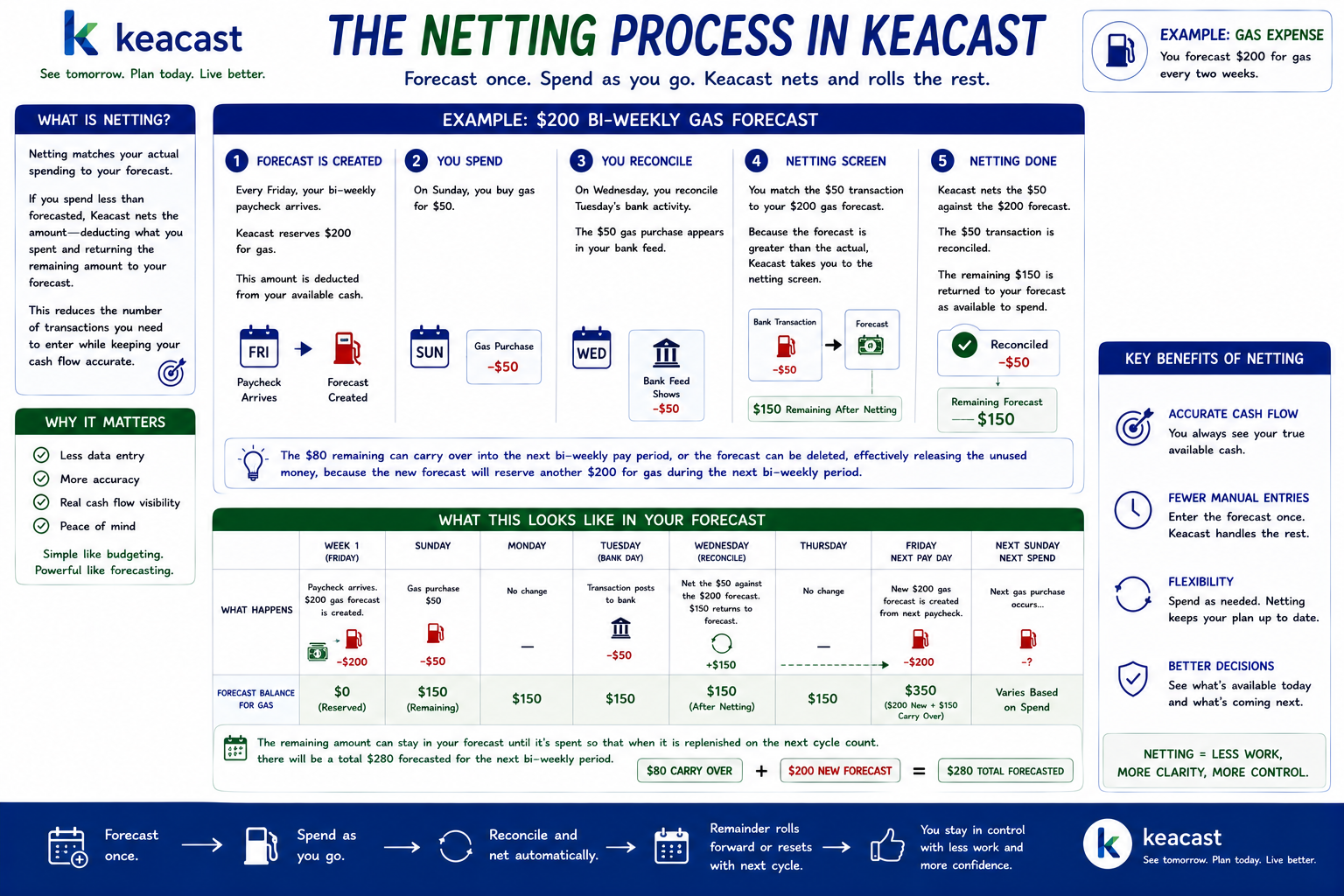
Imagine placing two hundred dollars into an envelope labeled Gasoline.
You spend fifty dollars filling your tank.
When you get home, there's still money left inside the envelope.
Would you throw the rest away because payday arrives tomorrow?
Of course not.
You'd leave it there.
Why?
Because your purpose hasn't changed.
The money still has a job.
Most of us naturally think this way.
Our financial software often doesn't.
The Hidden Problem with Starting Over
Many financial systems quietly assume that every new pay period is a fresh beginning.
A new paycheck arrives.
Categories reset.
Budgets restart.
Everything begins again.
But life doesn't actually work that way.
Your pantry doesn't empty itself because it's a new month.
Your fuel tank doesn't become empty because another paycheck arrived.
Your emergency fund doesn't disappear because the calendar changed.
Your financial responsibilities continue.
Shouldn't your financial planning continue as well?
Your Financial Intentions Didn't Change
This is one of the biggest ideas in the entire Keacast philosophy.
When you reserved money for gasoline...
...your goal wasn't to spend exactly two hundred dollars.
Your goal was much simpler.
"I want to make sure I always have enough money for fuel."
That's your intention.
Spending less than expected doesn't erase that intention.
It simply means reality required less money than you anticipated.
The purpose remains.
The remaining money should remain connected to that purpose.
That's why we say:
Netting protects your financial intentions.
Planning for Recurring Expenses
Think about all the expenses that don't happen exactly the same way every month.
Groceries.
Gasoline.
Household supplies.
Pet care.
Vehicle maintenance.
School expenses.
Home repairs.
Holiday shopping.
These aren't one-time purchases.
They're ongoing responsibilities.
Some months cost more.
Some months cost less.
The challenge isn't predicting the exact amount.
The challenge is consistently preparing for them.
That's what financial forecasting helps you accomplish.
Beyond Traditional Budgeting
Some people solve this challenge using sinking funds.
Others prefer the envelope budgeting method.
Both approaches recognize an important truth.
Money reserved for a future purpose shouldn't lose that purpose simply because time has passed.
Netting extends that same philosophy into your financial forecasting calendar.
Instead of restarting every pay period, your plan continues moving forward.
Just like life does.
Cash Flow Planning Without Waste
Have you ever noticed this subtle thought?
"There's still money left in this category... maybe I should spend it."
It's surprisingly common.
When money is treated like a monthly allowance, unused dollars can begin to feel like they should be consumed before the month ends.
Netting encourages a different mindset.
Unused money isn't wasted.
It's preserved.
Because your future responsibilities haven't disappeared.
They've simply moved farther down the calendar.
Why This Builds Financial Confidence
Imagine you're preparing for a long journey.
You pack extra water.
Extra snacks.
A flashlight.
A first-aid kit.
At the end of the first day, you discover you didn't use everything.
Would you throw those supplies away?
Of course not.
You keep them because the journey isn't over.
Financial planning works exactly the same way.
Reserved money continues serving the purpose you originally intended until that purpose has truly been fulfilled.
That's what creates lasting confidence.
A Financial Plan That Thinks Like You Do
One reason netting feels so intuitive is that it mirrors the way people already think.
You don't mentally divide your life into isolated months.
You think about ongoing responsibilities.
Your car will need fuel again.
Your family will buy groceries again.
Your home will need maintenance again.
Life is continuous.
Your financial planning should be continuous too.
Protecting More Than Dollars
Netting isn't really about preserving money.
It's about preserving purpose.
Every dollar you reserve represents a future intention.
A responsibility.
An opportunity.
A commitment you've already made to your future self.
When your financial plan protects those intentions, something remarkable happens.
Planning begins to feel less like accounting...
...and more like preparing for life.
Continue Your Financial Forecasting Journey
By now we've discovered that financial forecasting isn't simply about numbers.
It's about understanding movement.
Purpose.
Timing.
Planning.
But another fascinating pattern has quietly appeared throughout this series.
Every paycheck has a rhythm.
Every bill has a rhythm.
Every recurring expense has a rhythm.
Weekly.
Biweekly.
Monthly.
Quarterly.
Annually.
Those rhythms aren't just scheduling details.
They're the language your money has been speaking all along.
In the next chapter, Financial Forecasting: Understanding the Language of Time, we'll discover why learning that language may be one of the most important skills in personal financial planning.