Financial Forecasting: The Power of Seeing Money on a Calendar
The Keacast Philosophy Series – Episode 5 Why Visualizing Your Future Cash Flow Changes Everything Meta Description: Discover why seeing your money on a calendar improves financial forecasting, cash flow planning, and financial confidence by making future expenses easy to understand. URL Slug: /keacast-philosophy/financial-forecasting-calendar Primary Keyword: Financial Forecasting Secondary Keywords: Cash Flow Planning, Future Cash Flow, Financial Calendar, Expense Calendar, Planning...
The Keacast Philosophy Series – Episode 5
Why Visualizing Your Future Cash Flow Changes Everything
Meta Description: Discover why seeing your money on a calendar improves financial forecasting, cash flow planning, and financial confidence by making future expenses easy to understand.
URL Slug: /keacast-philosophy/financial-forecasting-calendar
Primary Keyword: Financial Forecasting
Secondary Keywords: Cash Flow Planning, Future Cash Flow, Financial Calendar, Expense Calendar, Planning Expenses, Financial Confidence
What If the Information Was Never the Problem?
Imagine someone handed you every piece of your financial information.
Every paycheck.
Every bill.
Every subscription.
Every mortgage payment.
Every insurance premium.
Every transfer.
Every savings goal.
Every recurring expense.
Nothing is hidden.
You have everything you need.
Would you automatically feel financially confident?
Most people assume the answer is yes.
But think about your own experience.
Many of us already have access to all of that information through banking apps, spreadsheets, budgeting software, and online banking.
Yet financial stress still exists.
Why?
Because having information isn't the same as understanding it.
That's one of the most important lessons in financial forecasting.
We've Organized Money Around Accounts Instead of Time
Nearly every financial tool presents your money in roughly the same way.
Checking account.
Savings account.
Credit card.
Investment account.
Transaction history.
Current balance.
Expense categories.
Everything is organized around where your money is.
Very little is organized around when your money moves.
That may sound like a small distinction.
In reality, it changes everything.
Imagine Planning Your Week Without a Calendar
Think about your daily schedule.
Suppose someone handed you nothing more than a list.
- Staff meeting
- Doctor appointment
- Dinner with friends
- Soccer practice
- School pickup
- Parent conference
Technically, every appointment is there.
But would you know whether two events overlap?
Would you immediately recognize your busiest day?
Would you know when you actually have free time?
Probably not.
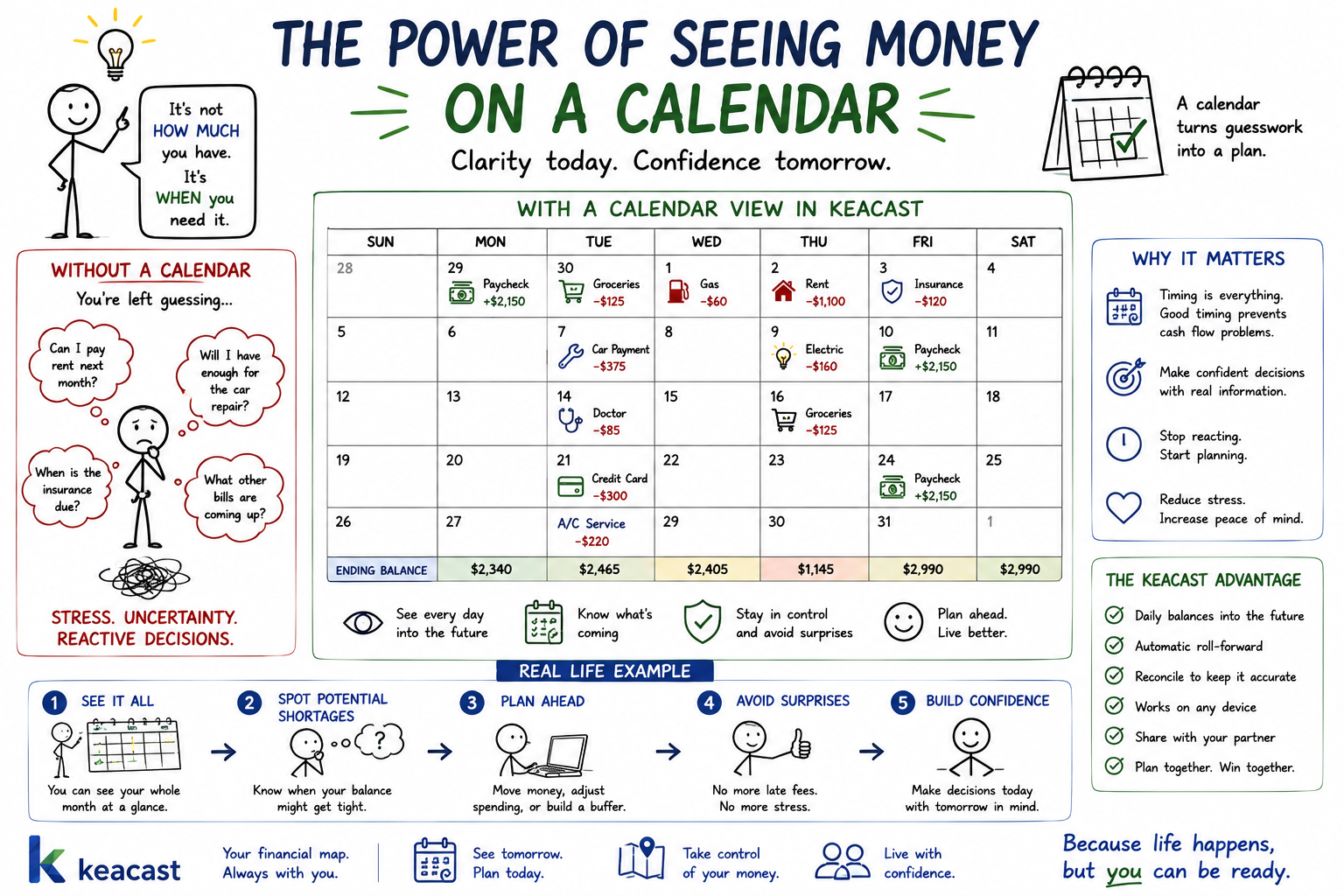
Now imagine seeing those exact same appointments on a calendar.
Nothing about the information changed.
Only the presentation changed.
Suddenly, everything makes sense.
Your financial life works the same way.
Your Brain Understands Pictures Faster Than Lists
Human beings naturally recognize visual patterns.
We glance at a weather radar and immediately understand an approaching storm.
We look at a road map and instantly recognize the fastest route.
We check a calendar and immediately understand a busy week.
Visual information reduces mental effort.
Instead of calculating, we recognize.
Financial forecasting becomes much easier when your money is organized visually instead of buried inside transaction lists.
Why a Financial Calendar Changes the Question
Traditional financial tools encourage us to ask,
"What happened?"
A financial calendar naturally encourages a different question.
"What's about to happen?"
That subtle shift changes the entire experience.
Instead of reviewing history, you're preparing for the future.
Instead of reacting, you're planning.
Instead of trying to remember every future expense, you can simply see it.
That's why cash flow planning becomes dramatically easier when your finances are displayed on a calendar.
Future Expenses Become Visible
Imagine looking at the next thirty days.
Your paychecks.
Mortgage payment.
Insurance premium.
Electric bill.
Streaming subscriptions.
Savings transfers.
Vacation.
Property taxes.
Everything appears on the exact day it matters.
Immediately, patterns begin to emerge.
You recognize weeks where cash flow is strong.
You recognize weeks where balances become tight.
You identify opportunities to move a purchase or postpone an expense before it creates unnecessary stress.
That's the real power of future cash flow planning.
Not better math.
Better visibility.
Financial Forecasting Is Like a Weather Forecast
Think about checking tomorrow's weather.
The forecast doesn't change whether it rains.
It changes how you prepare.
You bring an umbrella.
You leave earlier for work.
You postpone an outdoor event.
Financial forecasting works exactly the same way.
Your upcoming mortgage payment isn't the problem.
Your insurance premium isn't the problem.
Unexpected timing is often the problem.
A financial forecasting calendar allows you to see those events before they arrive.
Preparation replaces surprise.
Financial Confidence Begins When You Can See Ahead
Many people believe confidence comes from having more money.
Sometimes it does.
But confidence also comes from understanding what your existing money is going to do.
When tomorrow becomes visible, today's decisions become easier.
You stop guessing.
You stop relying on memory.
You stop wondering whether you've forgotten something important.
Instead, you simply look.
That's one of the greatest benefits of cash flow planning.
It transforms uncertainty into visibility.
Life Happens One Day at a Time
For years, we've organized our financial lives around balances and categories.
Those tools certainly have value.
But life doesn't happen inside categories.
Life happens one day at a time.
Paychecks arrive on specific days.
Bills are due on specific days.
Vacations begin on specific days.
Insurance drafts on specific days.
Every important financial event has a date attached to it.
That's why organizing money around time feels so natural.
It's how life actually works.
Continue Your Financial Forecasting Journey
By now, we've learned that financial confidence begins by seeing the future more clearly.
A calendar helps us understand when things will happen.
But another important question naturally follows.
Once we can see the future…
How do we actually build it?
How do we take future income, recurring bills, savings goals, and everyday expenses and create a living picture of tomorrow?
That's where financial forecasting truly begins.
In the next chapter, Financial Forecasting: Forecasting Your Future, we'll explore why forecasting isn't about predicting the future with perfect accuracy—it's about preparing for it with greater confidence.