Financial Forecasting: Why Reconciliation Keeps Your Financial Plan Alive
The Keacast Philosophy Series – Episode 7 How Daily Reconciliation Turns Financial Forecasting into Financial Confidence Meta Description: Learn why reconciliation is the key to accurate financial forecasting. Discover how connecting your forecast to real bank activity improves cash flow planning and financial confidence. URL Slug: /keacast-philosophy/reconciliation-financial-forecasting Primary Keyword: Financial Forecasting Secondary Keywords: Financial Reconciliation, Cash Flow Planning,...
The Keacast Philosophy Series – Episode 7
How Daily Reconciliation Turns Financial Forecasting into Financial Confidence
Meta Description: Learn why reconciliation is the key to accurate financial forecasting. Discover how connecting your forecast to real bank activity improves cash flow planning and financial confidence.
URL Slug: /keacast-philosophy/reconciliation-financial-forecasting
Primary Keyword: Financial Forecasting
Secondary Keywords: Financial Reconciliation, Cash Flow Planning, Future Cash Flow, Financial Forecasting Calendar, Personal Cash Flow, Financial Confidence
Every Financial Plan Eventually Meets Reality
Imagine planning a family road trip.
You know where you're going.
You've mapped your route.
You've estimated fuel costs.
You've booked your hotel.
You even know where you'd like to stop for lunch.
Then the trip begins.
Construction closes the highway.
Traffic slows your progress.
You discover a scenic route you hadn't planned.
Did your trip fail?
Of course not.
You simply adjusted.
Planning and adapting have never been opposites.
They're partners.
Your financial life works exactly the same way.
Why Financial Plans Sometimes Get Abandoned
Many people begin financial planning with enthusiasm.
They create a budget.
They organize their bills.
They develop a financial forecast.
Then life happens.
A grocery bill costs more than expected.
A paycheck is slightly different.
An unexpected repair appears.
Soon they begin thinking,
"Well... I guess my plan is ruined."
But here's the truth.
The plan wasn't ruined.
Life simply continued doing what life has always done.
It changed.
The problem isn't that plans change.
The problem is believing they were never supposed to.
Financial Forecasting Isn't Meant to Be Static
Earlier in this series we learned something important.
A financial forecasting calendar doesn't invent the future. It organizes it.
That means your forecast isn't trying to predict every surprise.
It's organizing everything you already know.
Paychecks.
Mortgage payments.
Insurance.
Subscriptions.
Savings goals.
Future expenses.
As new information arrives, the forecast should naturally evolve.
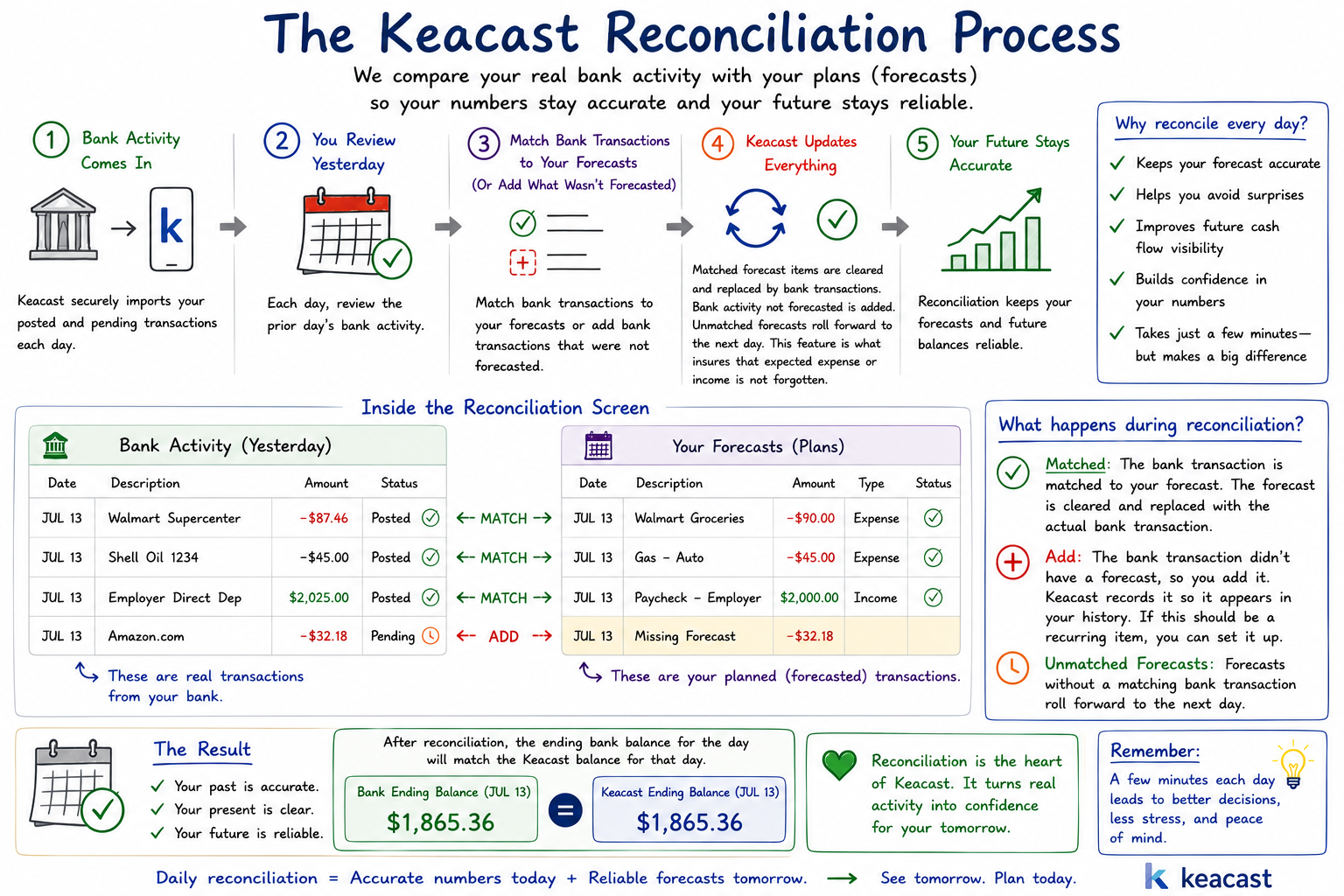
That's exactly what financial reconciliation accomplishes.
Reality Should Improve the Plan
Imagine planning a backyard barbecue.
You expected twenty guests.
Eighteen arrive.
Do you throw away the plan?
No.
You simply adjust.
Your shopping list changes.
Your seating changes.
Your food preparation changes.
The plan becomes more accurate because reality provided better information.
Financial reconciliation works the same way.
Yesterday's bank activity makes tomorrow's financial forecast more accurate.
Reality doesn't compete with the forecast.
It improves it.
Reconciliation Is a Conversation
The word reconciliation sounds technical.
Many people immediately picture accountants balancing spreadsheets.
That's not what we're talking about.
Think of reconciliation this way.
Your financial forecast says,
"Here's what we expected to happen."
Your bank account says,
"Here's what actually happened."
Reconciliation is simply the conversation between those two.
Not an argument.
Not a correction.
A conversation.
Yesterday informs tomorrow.
Tomorrow becomes clearer because today has finally arrived.
Why Daily Reconciliation Matters
Imagine steering a boat across a lake.
You don't wait until reaching the opposite shore to make corrections.
Tiny adjustments happen continuously.
A slight turn of the wheel.
A small correction.
Another small correction.
Each adjustment keeps the boat moving toward its destination.
Financial reconciliation works exactly the same way.
Instead of making one enormous correction months later, you make small daily adjustments.
Those tiny corrections protect your future cash flow.
They also dramatically reduce financial surprises.
The Forecast Doesn't Disappear
One of the biggest misconceptions about reconciliation is that reality replaces the forecast.
That's not what happens.
Your mortgage is still due next month.
Your insurance payment is still approaching.
Your vacation is still being planned.
Your savings goal still exists.
The future doesn't disappear simply because today has arrived.
Instead, your forecast becomes more accurate.
That's a very different philosophy than simply recording transactions.
Traditional financial tools often focus on documenting history.
Financial forecasting focuses on preparing for tomorrow.
Reconciliation connects those two worlds.
Why This Creates Financial Confidence
Think about updating directions in a GPS.
Suppose traffic forces you to leave your planned route.
Does the GPS say,
"Trip canceled."
Of course not.
It recalculates.
Immediately.
It uses new information to help you continue moving toward your destination.
Financial reconciliation works exactly the same way.
Your financial plan isn't broken because something changed.
It simply recalculates using better information.
That's how confidence grows.
Not because life became predictable.
Because your plan continues adapting.
A Living Financial Plan
One of the greatest strengths of financial forecasting is that it's alive.
It grows.
It adjusts.
It learns.
Every reconciled transaction improves your understanding of future cash flow.
Every paycheck updates the picture.
Every expense helps tomorrow become more accurate.
Instead of constantly starting over, your financial plan continuously evolves.
That's what makes it feel natural.
Life changes.
Your financial plan should too.
Financial Planning Should Reflect Real Life
Traditional money management often separates planning from reality.
One lives in a spreadsheet.
The other lives in your bank account.
Keacast approaches personal finance differently.
Planning and reality work together.
Your financial forecasting calendar organizes the future.
Reconciliation continuously connects that future to real life.
Together, they create something much more valuable than a static budget.
They create an always-current picture of your financial journey.
Continue Your Financial Forecasting Journey
By now we've learned something remarkable.
A financial forecast isn't valuable because it's perfect.
It's valuable because it continues learning.
But another fascinating question naturally appears.
What happens when reality only partially changes the plan?
Suppose you reserved $200 this pay period for gasoline.
Your first trip to the gas station only costs $48.
What happens to the remaining $152?
Should your financial plan simply forget about it?
Or should those dollars continue serving the purpose you originally intended?
That simple question introduces one of the most unique ideas in the entire Keacast philosophy.
In the next chapter, Financial Forecasting: How Netting Protects Your Financial Intentions, we'll explore why preserving the purpose behind your money may be just as important as tracking the money itself.
Related Keacast Resources
Continue exploring the Keacast approach to financial forecasting and reconciliation:
- Keacast Homepage – Learn about a new philosophy of personal finance Keacast.app.
- Financial Forecasting Calendar – Organize future cash flow around time instead of accounts.
- Financial Forecasting Features – Discover how forecasting, planning, and daily balances work together.
- Reconciliation – See how your financial forecast stays connected to actual bank activity.
- Shopping Lists – Connect everyday purchases to your future cash flow plan.
- Pricing – Explore subscription options designed for better financial planning. Note: No credit card needed, first 90 days are free with no obligation.