Financial Forecasting: Why Every Dollar Has an Amount and a Date
The Keacast Philosophy Series – Episode 3 Meta Description: Discover why every dollar has both an amount and a date—and how financial forecasting helps you plan future expenses, improve cash flow planning, and build financial confidence. URL Slug: /keacast-philosophy/every-dollar-has-an-amount-and-a-date Primary Keyword: Financial Forecasting Secondary Keywords: Future Cash Flow, Cash Flow Planning, Planning Expenses, Personal Cash Flow, Financial Confidence, Paycheck Planning We've Only Been...
The Keacast Philosophy Series – Episode 3
Meta Description: Discover why every dollar has both an amount and a date—and how financial forecasting helps you plan future expenses, improve cash flow planning, and build financial confidence.
URL Slug: /keacast-philosophy/every-dollar-has-an-amount-and-a-date
Primary Keyword: Financial Forecasting
Secondary Keywords: Future Cash Flow, Cash Flow Planning, Planning Expenses, Personal Cash Flow, Financial Confidence, Paycheck Planning
We've Only Been Taught Half of the Story
From the time we're children, we learn how to count money.
We learn addition and subtraction.
We learn about savings.
We learn about debt.
We learn interest rates, investments, and budgeting.
Nearly everything we learn about personal finance revolves around one question:
How much?
How much do you earn?
How much do you owe?
How much have you saved?
Those are important questions.
But there's another question that's just as important—one that most of us are never taught to ask.
When?
That one-word changes everything.
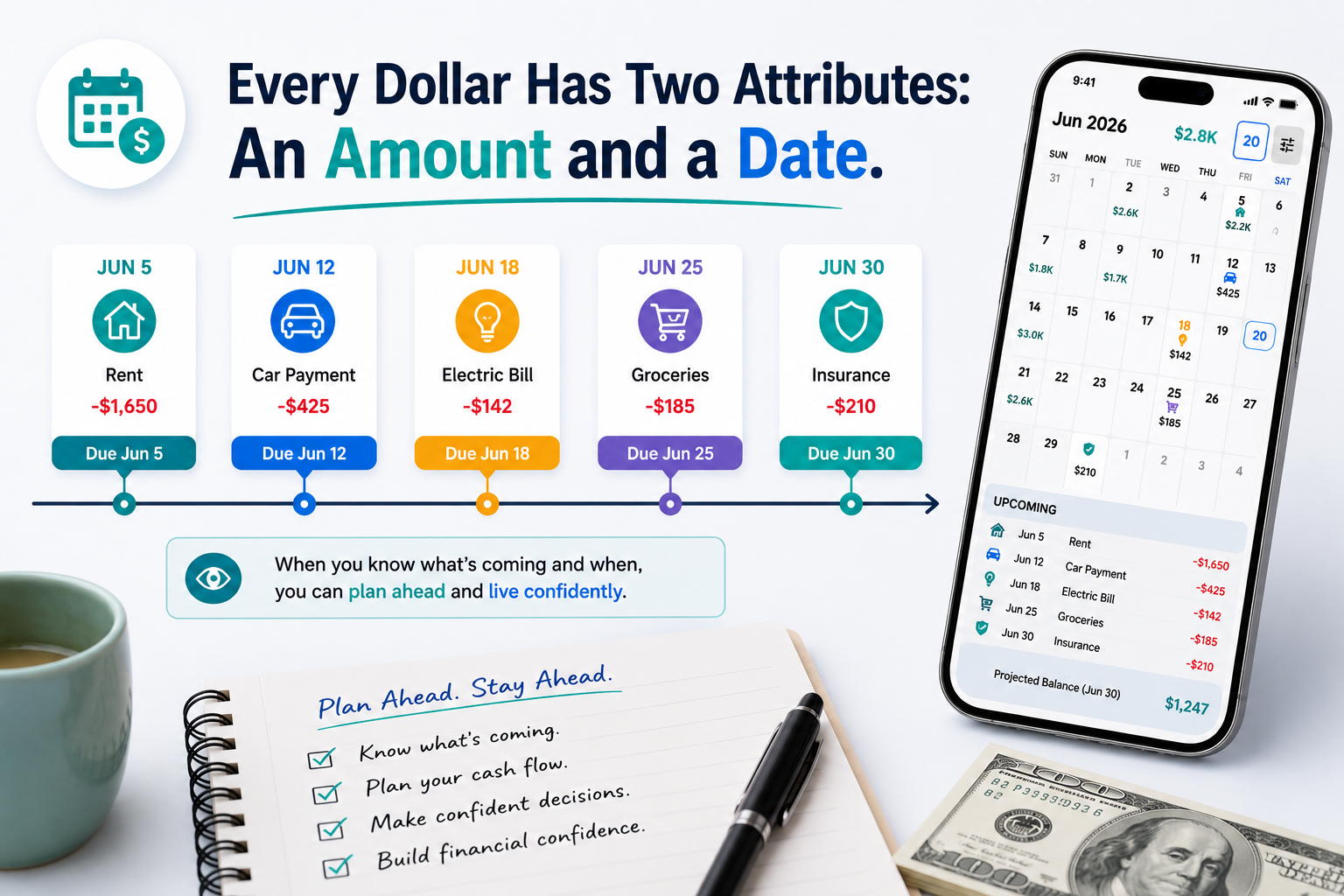
Every Dollar Has Two Attributes
Imagine someone hands you a one-hundred-dollar bill.
Everyone agrees on its value.
It's worth one hundred dollars.
Now imagine I ask a different question.
When will that money be needed?
Suddenly the answer isn't obvious.
Will you spend it tomorrow?
Will it pay next week's electric bill?
Is it reserved for your mortgage?
Is it part of your Christmas savings?
Has it already been mentally assigned to your next vacation?
The amount hasn't changed.
Only the timing has.
Yet that timing completely changes what the money means.
This is one of the most important ideas in financial forecasting.
Every dollar has two attributes:
- Its amount
- Its date
Ignore either one, and you only understand half of your financial picture.
Why Future Expenses Matter More Than Today's Balance
Suppose your checking account shows $3,500.
That sounds encouraging.
But what if this is also true?
- Rent is due tomorrow.
- Your insurance premium drafts on Friday.
- Your car payment clears Monday.
- Your annual property tax is due next week.
Suddenly, your balance tells a very different story.
Nothing changed about the amount.
What changed was your understanding of your future expenses.
That's why so many people feel financially uncertain.
They're looking at today's balance without seeing tomorrow's responsibilities.
We Learn Numbers. We Rarely Learn Timing.
Schools do an excellent job teaching mathematics.
Personal finance books often teach budgeting.
Banks show us balances.
Credit card companies show us statements.
Almost everything focuses on numbers.
Very little teaches us to think about time.
Yet nearly every important financial decision depends on timing.
Your paycheck isn't valuable only because of its amount.
It's valuable because of when it arrives.
Your mortgage isn't stressful because of its amount alone.
It's stressful if it arrives before your next paycheck.
The date is just as important as the dollars.
Your Paycheck Already Has a Job
Think about your next paycheck.
Long before it reaches your account, you've probably already assigned most of it.
Part will pay the mortgage.
Part will cover groceries.
Part may be reserved for gasoline.
Part may go toward savings.
Part may help pay for an upcoming vacation.
The paycheck hasn't arrived yet.
But mentally, much of it is already spoken for.
That's because your brain naturally performs paycheck planning.
The problem is that most people do this planning entirely in their heads.
And memory eventually becomes overwhelmed.
Cash Flow Planning Is Really About Timing
Imagine two families.
They earn the same income.
They spend roughly the same amount.
They have similar financial goals.
Yet one family feels calm while the other constantly worries.
Why?
Often, it isn't because one has more money.
It's because one understands the timing of their personal cash flow.
They know when income arrives.
They know when bills are due.
They understand how today's decisions affect future cash flow.
That's what cash flow planning really provides.
Visibility.
Why Timing Reduces Financial Stress
Think back to the last time you wondered,
"Can I afford this?"
Were you really asking about the purchase?
Or were you asking about everything that would happen afterward?
Would your next paycheck arrive in time?
Would your bills still be covered?
Would there be enough for the unexpected?
Those questions aren't about dollars alone.
They're about timing.
And timing is what transforms a balance into a financial plan.
Financial Forecasting Connects Amounts to Dates
This is where financial forecasting becomes incredibly valuable.
Instead of simply showing how much money you have today, forecasting helps connect every dollar to the time it will be needed.
Your paycheck isn't just income.
It's income arriving on a specific date.
Your mortgage isn't just an expense.
It's an obligation attached to a particular day.
Every financial event becomes more meaningful because it exists on a timeline.
That's how future cash flow becomes visible.
A Different Way to Think About Every Dollar
The next time money enters your account, pause for just a moment.
Instead of asking,
"How much did I receive?"
Ask,
"When will this money be needed?"
That single question changes the way you think.
Instead of seeing spending money, you begin seeing future responsibilities.
Instead of reacting to today's balance, you begin preparing for tomorrow.
That's the foundation of financial confidence.
Continue Your Financial Forecasting Journey
Once you begin thinking about both the amount and the date of every dollar, another question naturally appears.
If every dollar has a destination...
What is my money going to do next?
That simple question may be the most important one you ever ask about your finances.
In the next chapter, Financial Forecasting: What Is My Money Going to Do Next?, we'll explore why changing that one question can transform the way you make financial decisions every single day.